
Articulation Goals (School-Based) (PDF)

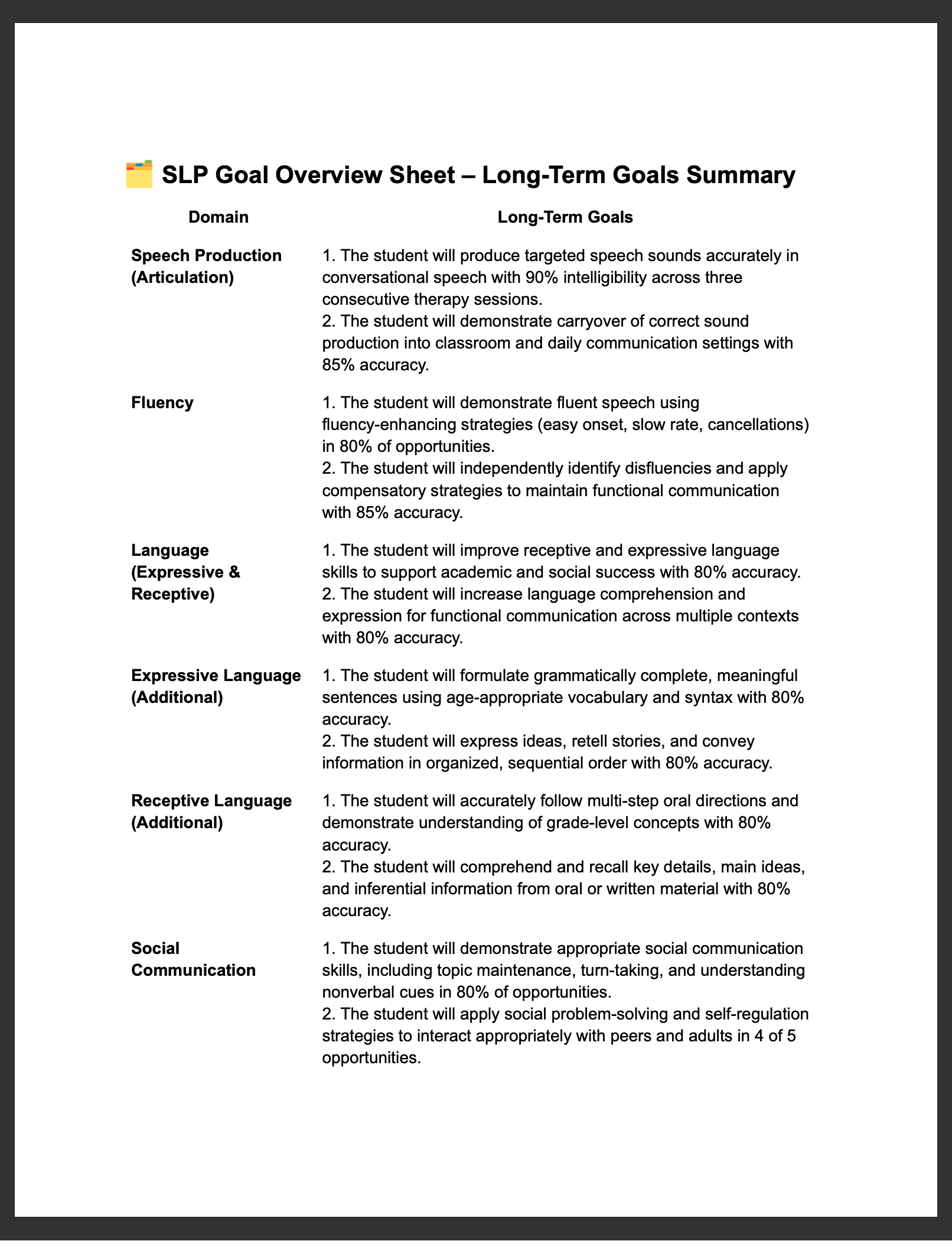
Articulation Goals (School-Based) (PDF)
Articulation goals in the school setting aim to improve clarity of speech by teaching students to produce target sounds correctly and consistently across increasingly complex contexts.
Goals typically begin with awareness and accurate production in isolation, then move through syllables and structured words, onto phrases and sentences, and finally generalization in conversational speech and academic settings.
Progression is structured and measurable, using accuracy percentages, cue reductions, and contextual demands (e.g., single words vs. reading aloud vs. spontaneous classroom discussion).
Representative goal areas and examples
Stimulability and sound awareness: Establish the child’s ability to perceive and attempt target sounds. This step includes auditory discrimination tasks and simple imitative production with maximal cues.
Isolation to syllable shaping: Teach accurate articulatory placement in isolation and CV, VC, and CVC syllables to stabilize the motor pattern.
Word-level accuracy: Achieve consistent correct production of the target sound in single words, initially in controlled positions (initial, medial, final), then across varied word positions and complexities.
Phrase and sentence-level carryover: Produce the target sound accurately in structured phrases and sentences, with decreasing clinician cues and increasing length/complexity.
Conversational/generalization: Maintain target production at a specified accuracy (e.g., 80–90%) during spontaneous conversation, classroom participation, and academic tasks such as reading aloud or oral presentations.
Contextual and linguistic complexity: Generalize accurate productions across phonetic contexts (clusters, blends), multisyllabic words, and across speaking tasks (narratives, explanations, play-based interactions).
Reduced cueing and self-monitoring: Increase independence by fading clinician prompts and teaching self-monitoring strategies (error detection, self-correction).
Carryover to academic participation: Ensure intelligibility during curriculum tasks—answering questions, participating in group discussions, and delivering oral reports—with target accuracy standards that support classroom functioning.
Maintenance: Demonstrate stable production over time after intervention reduces, monitored through periodic probes to ensure long-term retention.
Each goal is written with observable, measurable criteria: target sound(s), context (isolation, syllable, word, phrase, sentence, conversation), accuracy threshold (commonly 80–90% for conversational goals), cue level (maximal, moderate, minimal, independent), and timeframe (e.g., 8–12 weeks or by the end of the grading period). Goals are individualized based on severity, stimulability, age, language skills, and classroom demands.
Implementation notes:
Use hierarchical drill, phonetic placement, tactile/visual cues, minimal pairs, and structured conversational tasks.
Collaborate with teachers to incorporate target practice into classroom routines and natural communication opportunities.
Involve families with home practice activities aligned to school goals, using concise practice plans that emphasize quality over quantity.
Monitor progress with periodic probes across contexts to adjust targets, cueing, and complexity.
This framework supports writing 15 specific articulation goals tailored to a student’s needs—spanning early sound establishment through fluent, classroom-ready production—while providing clear criteria for progress and generalization.